Growth
ChatGPT Ads vs Google Ads: Which Is Better for Your Business?
With ChatGPT ads rolling out to 900 million+ users, every advertiser is asking the same question: how do they compare to Google Ads? Should I shift budget? Can I use both?
6 min read
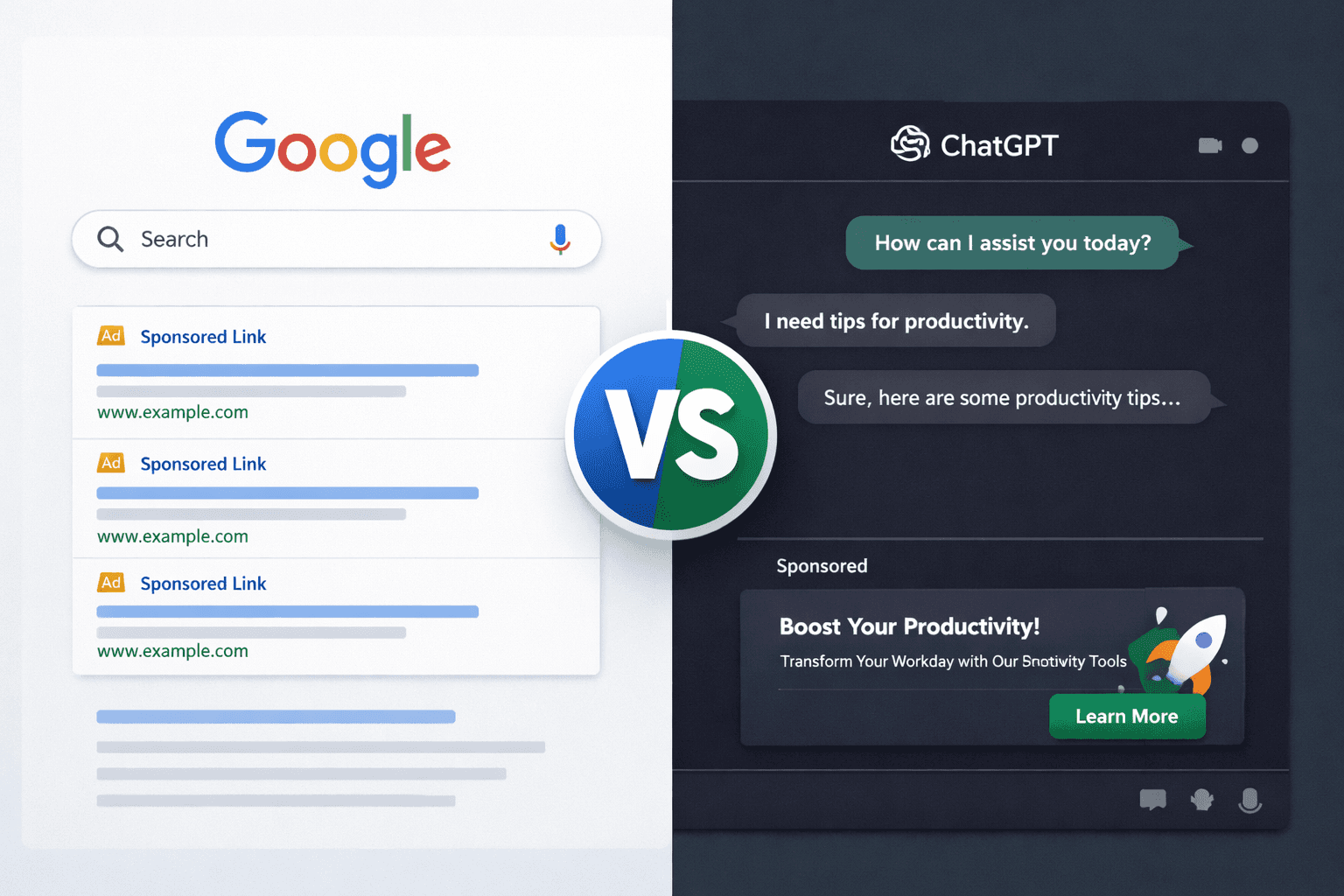
ChatGPT Ads vs Google Ads: Which Is Better for Your Business?
With ChatGPT ads rolling out to 900 million+ users, every advertiser is asking the same question: how do they compare to Google Ads? Should I shift budget? Can I use both?
Here's an honest, side-by-side comparison based on what we know so far.
What Is the Main Difference Between ChatGPT Ads and Google Ads?
The fundamental difference comes down to context.
Google Ads captures demand through keywords. Someone searches "best CRM for small teams," they have intent, and you bid on that keyword.
ChatGPT Ads captures demand AND context through conversation. Someone tells ChatGPT: "I'm running a 10-person remote team and we're struggling to keep track of customer follow-ups. We tried spreadsheets but it's getting messy. What should we use?"
Google knows what you searched. ChatGPT knows what you searched, why you're searching, what you've already tried, your team size, and your specific pain point. That depth of context makes ad matching significantly more precise.
How Does Targeting Compare Between ChatGPT Ads and Google Ads?
Google Ads targeting is primarily keyword-based. You bid on search terms and use audience signals as secondary targeting. You know what someone searched, but not much about who they are or the full story behind their search.
ChatGPT Ads targeting is conversation-based. The AI understands demographics, pain points, preferences, and intent from the entire conversation, not just a single query. This combines Meta's deep personal targeting with Google's search intent in one platform.
ChatGPT ads have a targeting advantage because the full conversation provides far more context than a single search query.
Which Platform Has Higher Intent: ChatGPT or Google?
Google Ads has high intent, but it's variable. "Best CRM software" signals buying intent. "What is a CRM" is purely informational. You spend significant effort filtering intent quality through keyword selection, match types, and negative keywords.
ChatGPT Ads have very high intent on average. People use ChatGPT for research and decision-making. The conversational nature naturally filters for users who are further down the buying funnel. When someone asks "Which CRM should I use for my remote team?", they're actively making a decision, not just browsing.
ChatGPT conversations tend to be more decision-oriented than Google searches, which means higher average intent quality.
How Do ChatGPT Ad Costs Compare to Google Ads?
Google Ads costs vary by industry. Competitive keywords like "CRM software" cost $10-20+ per click. Average CPC across industries is ~$5. The auction system is mature with decades of optimization tools and data.
ChatGPT Ads costs are currently priced at approximately $60 CPM (cost per thousand impressions). This is premium pricing. No per-click pricing model has been announced yet. The self-serve platform isn't fully launched, so pricing will likely evolve.
Metric | Google Ads | ChatGPT Ads |
|---|---|---|
Pricing model | CPC (per click) | CPM (per 1,000 impressions) |
Average cost | ~$5 CPC | ~$60 CPM |
Competitive keywords | $10-20+ CPC | TBD |
Budget flexibility | High (daily budgets, bid caps) | Limited (still early) |
Google Ads currently offers more pricing flexibility and optimization levers. ChatGPT's pricing will likely become more competitive as the platform matures.
Which Platform Has Better Ad Formats?
Google Ads offers text ads in search, Shopping ads with images and prices, Display ads across millions of websites, YouTube video ads, Performance Max campaigns, and app install ads. Decades of format innovation.
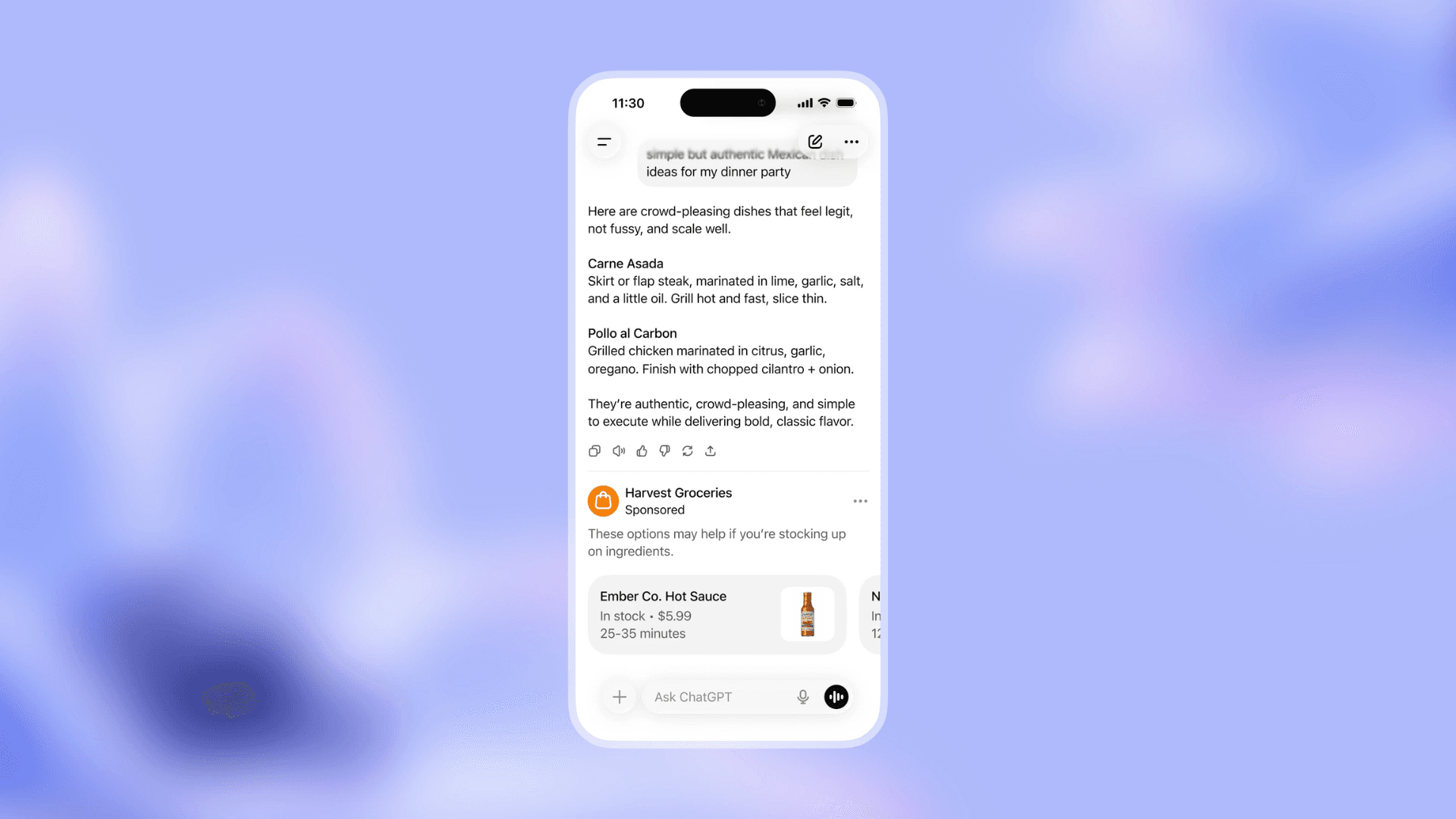
ChatGPT Ads are currently limited to sponsored product/service cards at the bottom of answers. OpenAI has signaled future formats including conversational ads (ask questions directly to brands) and Shopify-integrated checkout. Early stage but high innovation potential.
Google Ads wins on format variety today. ChatGPT has more disruptive potential for the future. Imagine asking a brand questions before buying, directly inside the AI conversation.
How Does Conversion Tracking Compare?
This is where the biggest gap exists.
Google Ads tracking is mature and sophisticated. Google Tag, enhanced conversions, offline conversion imports, attribution modeling, automated bidding based on conversion data. You can track exactly which keyword, ad, and campaign drove every sale.
ChatGPT Ads tracking from OpenAI is nonexistent. Advertisers get "high-level" metrics only, meaning impressions and clicks. No way to measure which ads drive purchases, signups, or leads. No ROAS calculation possible through OpenAI's dashboard.
This is ChatGPT ads' biggest weakness right now. At $60 CPM, you need to know what's working.
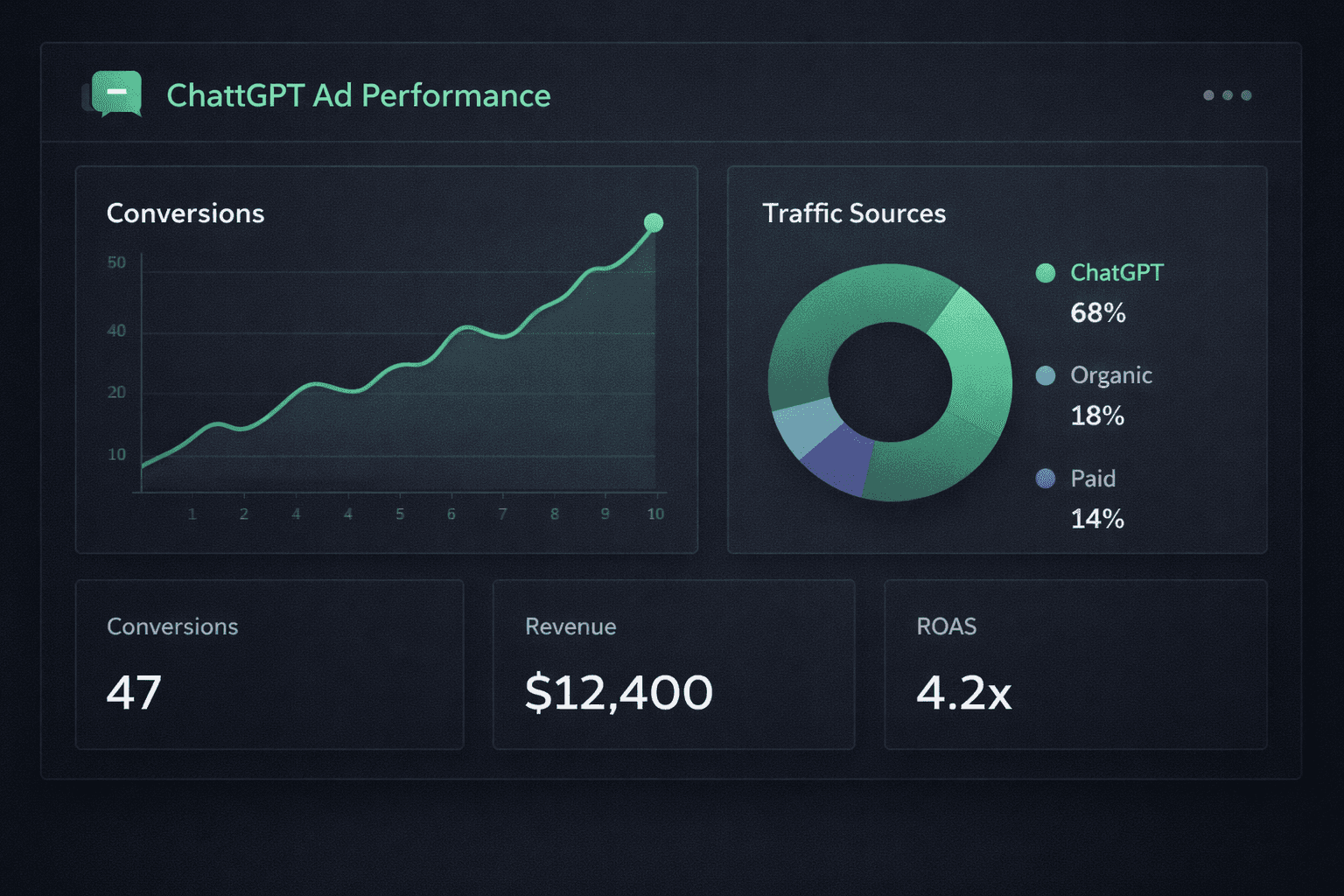
The solution: Third-party tracking pixels like AdConvo's pixel detect ChatGPT traffic on your website and attribute conversions, giving you ROI visibility similar to what you're used to with Google Ads.
Which Platform Has More Competition?
Google Ads is extremely competitive. Every business in the world advertises on Google. CPCs have increased year over year for over a decade. Standing out requires significant budget, expertise, and ongoing optimization.
ChatGPT Ads have almost no competition yet. Large enterprises need months of internal approval before testing new channels. The self-serve ad manager isn't fully live. Early advertisers face minimal competition and get premium placement at lower effective costs.
This mirrors the early days of Google Ads and Facebook Ads. The advertisers who moved first built massive businesses at a fraction of today's costs.
Do Users Trust ChatGPT Ads More Than Google Ads?
Google Ads suffer from ad blindness. Many users automatically skip sponsored results. Trust in Google ads has declined over the years as the line between organic and paid results has blurred.
ChatGPT Ads benefit from a trust premium. Users trust ChatGPT's responses like advice from a knowledgeable friend. An ad appearing alongside a trusted AI recommendation carries significant weight. However, this trust could erode if ads become too aggressive. OpenAI seems aware of this risk based on their published ad principles.
ChatGPT currently has a trust premium that Google has largely lost. This won't last forever, which is another reason to move early.
When Should I Use ChatGPT Ads Instead of Google Ads?
ChatGPT ads are likely better for your business if:
You sell B2B products or services where buyers research and compare options
You have high-value conversions (the $60 CPM is easier to justify with $500+ deals)
You want to reach users during the research and decision phase
You're willing to be an early mover on a new platform
Your product solves a problem people ask AI about (software, professional services, education, health)
When Should I Stick with Google Ads?
Google Ads is likely better if:
You need mature tracking and optimization tools with full attribution
You sell low-ticket products where $60 CPM is hard to justify
You need precise budget control with per-click pricing
You want access to Display, YouTube, and Shopping ad formats
You're in a space where people search but don't ask AI (local emergencies, very simple purchases)
Can I Use Both ChatGPT Ads and Google Ads Together?
Yes, and this is the smart play. The best advertisers won't choose one or the other. They'll use both strategically:
Google Ads for bottom-of-funnel, high-intent keyword capture with mature tracking
ChatGPT Ads for mid-funnel research-stage users with deep contextual targeting
The two platforms complement each other. Google catches people who know what they want. ChatGPT catches people who are figuring out what they want.
The key challenge is measuring ChatGPT ad performance alongside Google Ads. Without conversion tracking from OpenAI, you need a third-party solution to understand your cross-platform ROI.
How Do I Track ChatGPT Ad Performance?
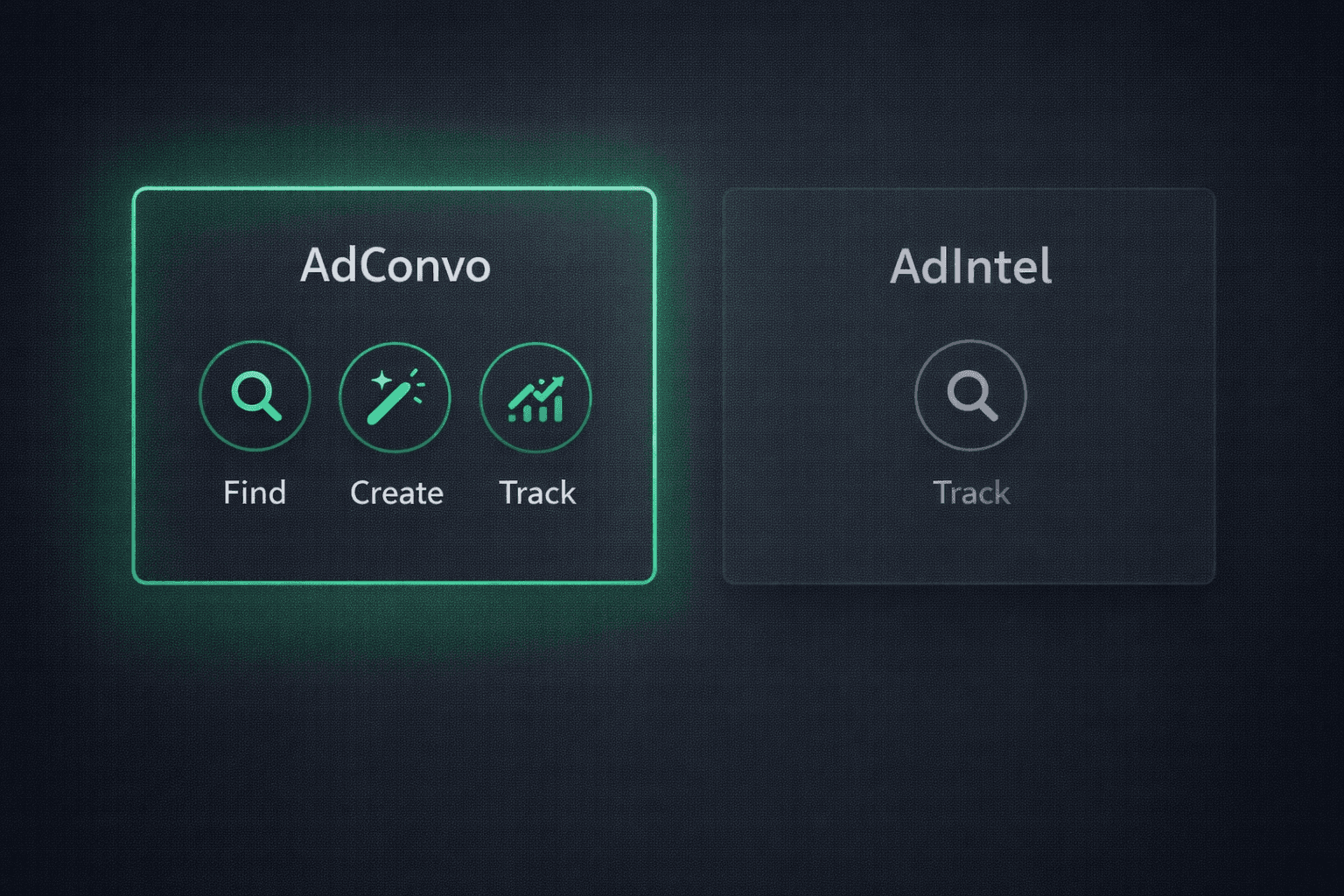
AdConvo solves the tracking gap with a pixel built specifically for ChatGPT ads. It sits on your website, detects ChatGPT traffic, and tracks conversions, giving you the same ROI visibility you're used to with Google Ads. Plus, AdConvo helps you spy on competitor ChatGPT ads and generate winning ad copy with AI.
You shouldn't have to choose between a powerful new channel and knowing whether it works.
Join 500+ businesses on the AdConvo waitlist →
Last updated: February 2026
View more articles
Learn actionable strategies, proven workflows, and tips from experts to help your product thrive.